
Karryn’s Prison Screenshots









Karryn’s Prison review
Exploring the innovative gameplay design and narrative integration of this indie title
Karryn’s Prison stands out as a uniquely designed indie game that seamlessly weaves narrative storytelling with interactive mechanics. The game’s central mechanic—a corruption system—isn’t merely a gameplay feature but an integral part of the character’s story arc. Players make deliberate choices throughout their experience, directly influencing the protagonist’s journey and transformation. This article explores what makes Karryn’s Prison a standout title in indie gaming, examining its innovative approach to merging story and mechanics, the satisfaction players derive from its systems, and why it has garnered attention from the gaming community.
Understanding Karryn’s Prison: Core Gameplay & Design Philosophy
Ever find yourself playing a game where the story and the stuff you actually do feel totally disconnected? 😩 You’re told you’re a heroic warrior, but you spend 20 hours picking flowers to upgrade your boots. The narrative says one thing, but the Karryn’s Prison gameplay mechanics whisper something else entirely. It’s a common disconnect in game design.
Well, imagine a game where every button press, every menu you open, and every choice you make is in perfect, devilish harmony with the story it’s telling. That’s the genius of Karryn’s Prison. This isn’t just another indie title; it’s a masterclass in interactive narrative game design, where the core loop and the central theme aren’t just friends—they’re inseparable. The entire experience orbits around one brilliant, integrated idea: the corruption system indie game fans are talking about.
Let’s pull back the curtain on this prison and explore how its unique Karryn’s Prison game design philosophy creates something truly memorable.
What Makes the Corruption Mechanic Revolutionary 🧠
At its heart, the corruption mechanic in Karryn’s Prison is deceptively simple. It’s a number—a percentage that represents the protagonist’s, well, moral and physical decline. But calling it a simple “morality meter” would be a massive undersell. This is the game’s central engine, its primary resource system, and its main narrative compass, all rolled into one.
Here’s the revolutionary part: nothing happens to you against your will. 😲
Unlike games where a character might be “corrupted” through cutscenes or scripted events you have no control over, Karryn’s Prison places the agency—and the temptation—firmly in your hands. The game presents you with a management simulator: you are the warden of a prison filled with unruly male inmates, and you must manage facilities, assign labor, and keep order. You can play this straight, using discipline and traditional management. It’s hard, grueling work.
But the game also offers you shortcuts. Tired of an inmate refusing to work? You can “persuade” him through more intimate means. Need to de-stress after a long day? There are activities that will lower your stress… while raising that corruption percentage. Every tempting shortcut, every easier path forward, is a conscious choice you make.
“The first time I realized I was choosing to fail, that I was actively clicking the button to make Karryn weaker for a short-term gain, it blew my mind. The game wasn’t punishing me; I was optimizing my own downfall, and it felt weirdly powerful.” – A player’s experience.
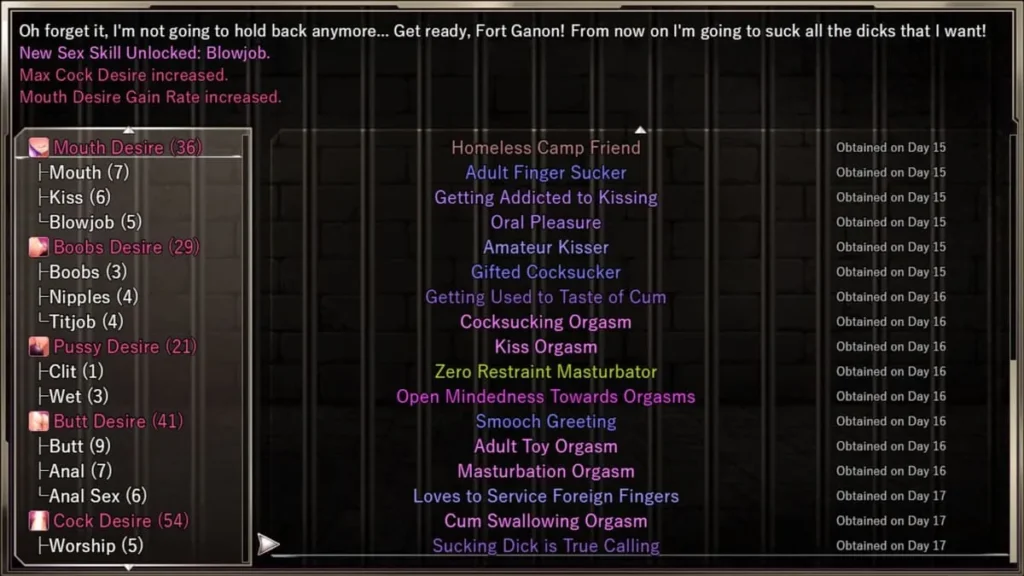
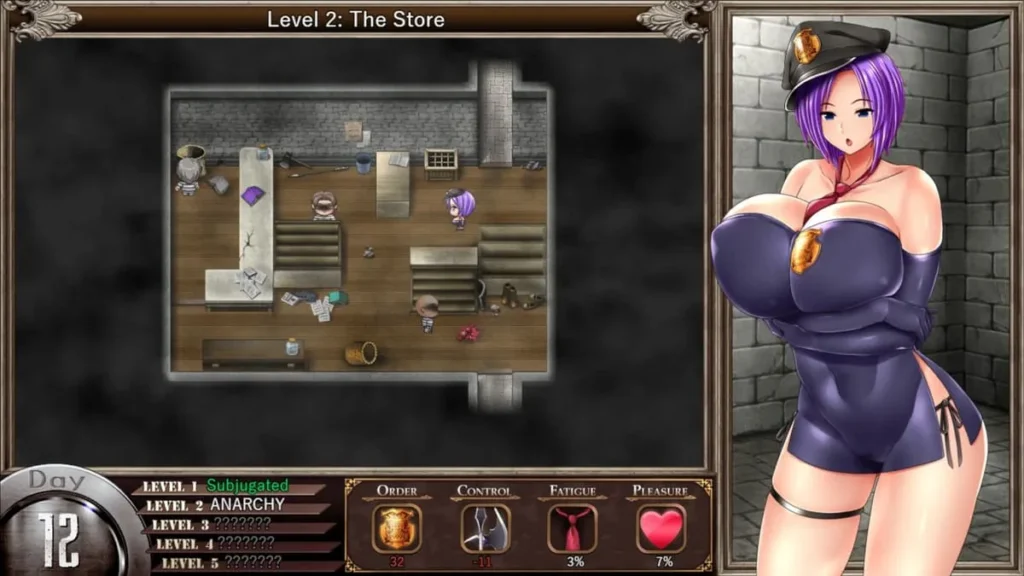
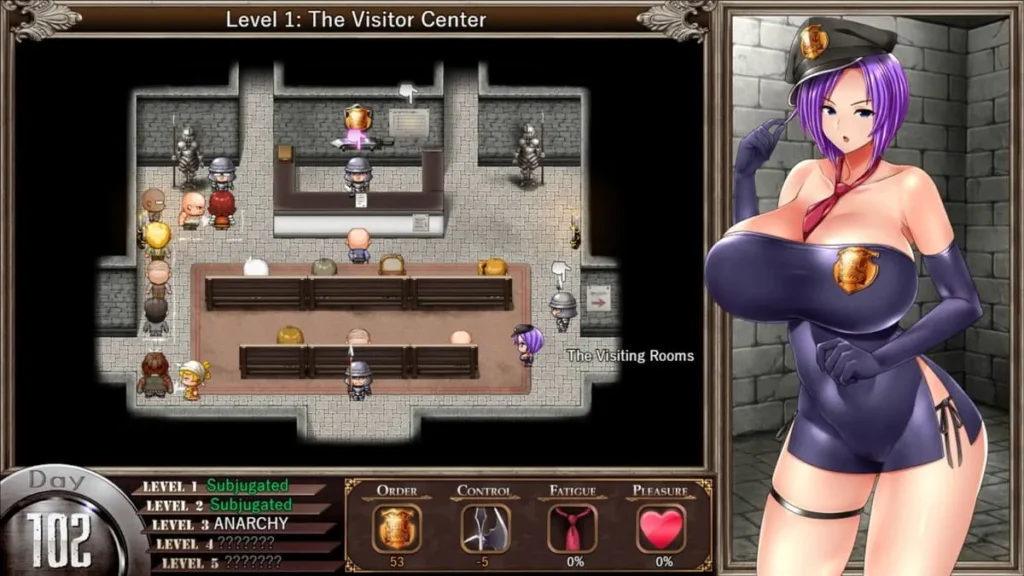
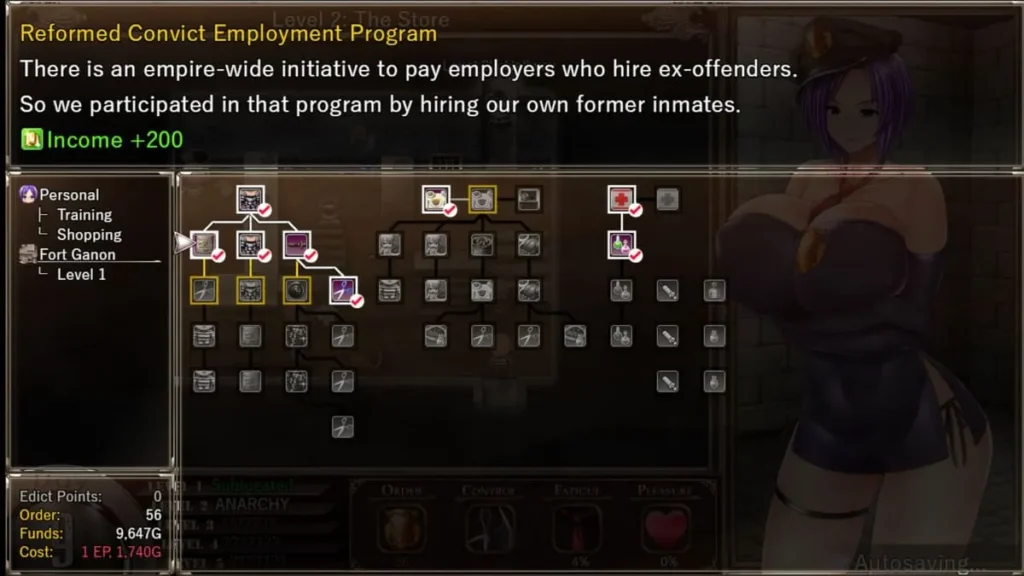
This is where the character progression corruption system shines. Progression in most games is about getting stronger, smarter, faster. Here, progression is often about giving in. New abilities, access to new areas, and even story beats are locked behind higher corruption levels. To “progress,” you must choose to compromise. Your stats might shift from Strength and Willpower to more… sensual specialties. The game’s UI, music, and even character portraits evolve visually as the number climbs, providing constant feedback on the path you’ve chosen.
This creates an incredible push-pull tension. You want to progress the story and unlock new gameplay options (which requires corruption), but you might also feel a strange sense of protectiveness over Karryn’s original state. The corruption system indie game design makes you complicit in the narrative, not just a spectator.
For example, early on, you might be stuck because an inmate is too strong to discipline physically. The game presents options:
* Grind for days to build up traditional stats (Hard Path).
* Use a corrupting “persuasion” method to instantly break his will (Easy Path, +Corruption).
The choice is always yours. This seamless blend is the core of Karryn’s Prison gameplay mechanics.
| Traditional Game Progression | Karryn’s Prison Progression |
|---|---|
| Gain XP, level up, choose skills from a tree. | Choose corrupt acts, increase corruption %, unlock corrupted skills & story paths. |
| Find keys or tools to open new areas. | Reach a corruption threshold that allows “alternative” access to restricted areas. |
| Story advances after defeating a boss or completing a quest. | Story branches and advances when your corruption unlocks new character interactions and states. |
| Character strength is visual (bigger armor, glowing weapons). | Character “progression” is visual (changed expressions, outfits, and aura). |
How Player Choice Shapes the Narrative Experience 🎭
This brings us to the beating heart of the experience: player choice narrative integration. In Karryn’s Prison, choice isn’t a binary “be good or be evil” at key story junctions. It’s a constant, granular, and systemic reality.
Every day in the prison is a series of small choices that compound. Do you spend your limited energy on paperwork to run a tight ship, or do you “interrogate” a prisoner to lower your stress? Do you build a shower to improve inmate hygiene (a neutral management decision), or do you build a brothel to generate income and massively increase corruption? These aren’t just gameplay decisions; they are narrative ones. They define who Karryn is becoming, moment by moment.
The narrative doesn’t branch in huge, sweeping ways from single dialogue picks. Instead, it evolves organically based on the mechanical state of your character. Different events, character interactions, and dialogue lines will trigger based on your corruption level, your stress, and even specific fetishes you may have developed through play. This is indie game mechanics storytelling at its most sophisticated.
The game respects your agency completely. There is no “Game Over” for becoming too corrupt, and there’s no punishment for staying pure (aside from the immense difficulty). There are only consequences and different stories. A low-corruption run tells a story of grim determination and exhausting resilience. A high-corruption run tells a story of hedonistic surrender and the embrace of new power. Both are valid. Both are the “real” story, because you authored it through your actions, not your dialogue selections.
This creates incredible replay value. You’re not replaying to see a different 30-second cutscene; you’re replaying to experience a fundamentally different management sim and character arc. The Karryn’s Prison game design trusts the player to find their own story within the systems, making the narrative feel earned and personal.
Think of it like this: In most games, you watch a cutscene of your character making a tough choice. In Karryn’s Prison, you live that tough choice through the gameplay loop for hours before the game acknowledges it narratively. The satisfaction comes from the system itself nodding at you and saying, “I see the path you’ve walked. Let’s proceed accordingly.” 🛤️
The Integration of Story and Mechanics 🔗
This is where Karryn’s Prison ascends from a clever game to a landmark piece of interactive narrative game design. The integration isn’t a feature; it’s the foundation. The themes of power, control, surrender, and corruption aren’t just things the story talks about—they are things you perform through the mechanics.
Let’s break down this integration:
-
Thematic Mechanics: Every core mechanic reflects the theme. Managing “Stress” and “Libido” isn’t just a bar to manage; it’s the internal struggle of the character. “Corruption” isn’t a bad ending; it’s a primary resource. Even the combat/encounter system is framed as “disciplinary actions” that can be resolved through force or through corrupt, intimate means. The how of playing is the what of the story.
-
Narrative as Reward: In many games, you play the mechanics (combat, puzzles) to unlock the story (cutscenes). Here, engaging with the corrupting mechanics is how you unlock narrative. Choosing a corrupt action often immediately yields a small narrative beat—a line of dialogue, a character’s reaction, a change in a relationship. The story is the direct feedback for your gameplay choices.
-
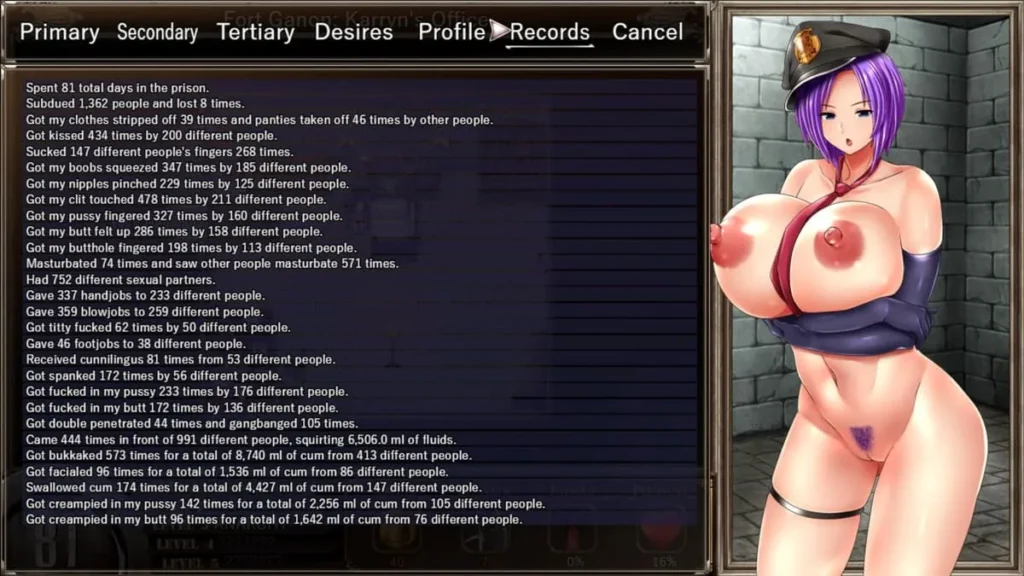
Mechanical Evolution as Character Arc: Your character sheet literally tells the story of Karryn’s transformation. As stats like “Will” decrease and stats like “Sensitivity” increase, you are watching her character arc unfold in a spreadsheet. A new skill you unlock isn’t just a combat move; it’s a milestone in her corruption. This is the ultimate fusion of character progression corruption and storytelling.
-
Environment Telling the Story: The prison itself changes visually as your corruption rises. Colors may become more lurid, lighting more suggestive, and ambient sounds more decadent. The world reacts to your mechanical state, reinforcing the narrative without a single word of dialogue.
This clever blurring of lines is why the game resonates so deeply. It creates a level of immersion that scripted narratives often struggle to achieve. You aren’t just told Karryn is struggling with temptation; you feel the temptation every time you’re low on resources and that easy, corrupt option glows enticingly on the screen. You are the source of the drama.
The Karryn’s Prison gameplay mechanics and narrative are in a constant dance, each leading and following. This philosophy—that the “fun” of the gameplay loop should be thematically married to the story’s soul—is what sets it apart from traditional indie games. It’s not just a visual novel with some management mini-games tacked on, nor is it a management sim with a story pasted over it. It is a complete, cohesive whole where play and plot are the same thing.
For players, this delivers a profound sense of satisfaction. Every gain feels earned, and every loss feels like a conscious step on a chosen path. There’s no dissonance, only harmony—a harmony that, in this case, is beautifully, brilliantly corrupt. 🎻 It’s a testament to how powerful indie game mechanics storytelling can be when a developer has a clear, unified vision and the courage to let the player’s choices truly steer the ship into uncharted, and often compromising, waters.
Karryn’s Prison represents a thoughtful approach to indie game design, where mechanics and narrative work in harmony rather than existing separately. The corruption system serves as both a gameplay progression tool and a narrative device, giving players meaningful agency in shaping the protagonist’s journey. What elevates this title is its respect for player choice—the game doesn’t force corruption upon players but instead allows them to make deliberate decisions that feel consequential. The clever integration of story and mechanics creates a cohesive experience that resonates with players seeking depth and innovation in indie gaming. For those interested in games that prioritize narrative-mechanical integration and player agency, Karryn’s Prison offers a compelling case study in how indie developers can create memorable, satisfying experiences that challenge traditional game design conventions.